
#HOWCEE RADIO Host FREDDIE C. HOWARD Ask Americans!

What is happen in America? Will Donald J Trump Bring America to Marshall Law?, with his lawless leadership?
Story by Emily Standley Allard
https://www.msn.com/en-us/channel/source/Socialbuzzhive%20by%20Emily%20Standley%20Allard/sr-cid-98e972951fb04af3
What is Martial Law?
Martial law refers to the temporary substitution of military authority for civilian governance, typically enacted during emergencies when civil authorities are unable to function effectively.
Under martial law, military officials may assume control over law enforcement, judicial processes, and other governmental functions, often leading to the suspension of certain civil liberties, such as the writ of habeas corpus. Continue reading
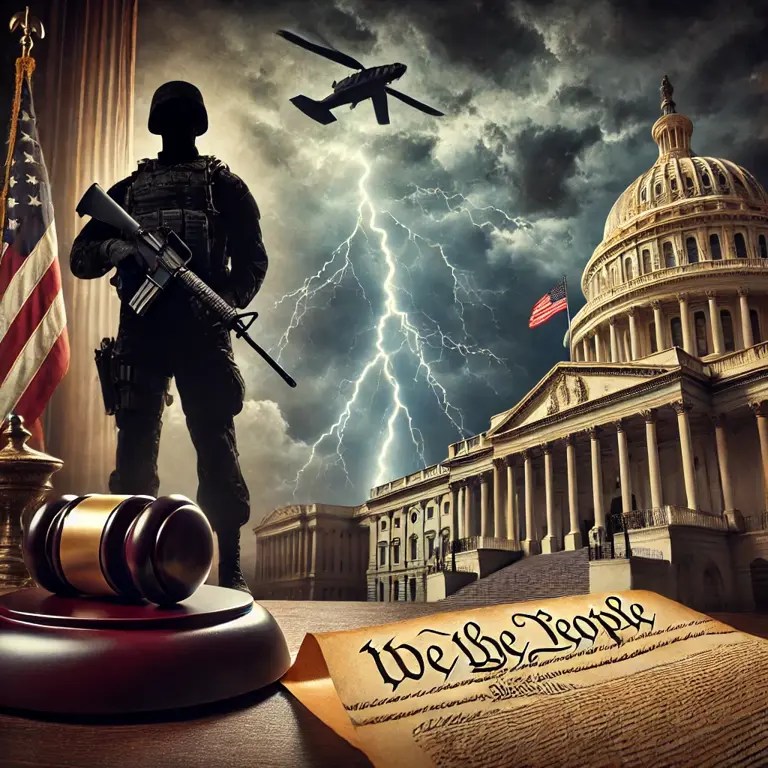
The mere mention of martial law stirs intense debate, conjuring images of military-enforced curfews, suspended freedoms, and a nation teetering on the edge of authoritarian rule. In the United States—where democracy, civilian governance, and constitutional rights are deeply ingrained—the idea remains a rare and extreme measure, historically reserved for moments of national crisis.
But as 2025 unfolds, political rhetoric and shifting power dynamics have reignited fears of its potential misuse.
The Heritage Foundation, President Donald Trump’s controversial Project 2025 plan, and his infamous remark about acting as a “dictator on Day 1” as well as the dismantling of government institutions recently with DOGE, have fueled speculation about whether the legal guardrails and the Constitution, which is supposed to protect civilian freedoms are as strong as we assume.
With ongoing debates about executive power, civil unrest, and national security threats, Americans are left wondering: Could martial law actually happen? And what would it mean for the future of the country?
This article unpacks the historical precedent, legal framework, and real-world implications of martial law in the U.S., while drawing comparisons to global events and dissecting how modern political strategies could test the limits of democracy in 2025.
Project 2025: A Controversial Blueprint for Expanding Executive Power and Federal Control
Project 2025, an initiative associated with Donald Trump’s second term plans, outlines a vision for consolidating executive authority and restructuring federal agencies to align more closely with conservative priorities.
Critics have raised concerns that elements of this plan could provide a framework for actions resembling martial law under the guise of restoring order during crises.
The project includes strategies for deploying federal law enforcement and military resources domestically, which some view as overreach into areas traditionally governed by state and local authorities.
Supporters argue that Project 2025 is necessary to counteract what they see as bureaucratic inefficiency, overregulation and ensure federal responsiveness, while opponents caution against the erosion of civil liberties and democratic norms.
Historical Instances of Martial Law in the United States
Throughout U.S. history, martial law has been declared at least 68 times, primarily in localized areas and under specific circumstances. These instances include responses to war or invasion, domestic insurrection, civil unrest, labor disputes, and natural disasters.
Notable examples include:
- War of 1812: General Andrew Jackson imposed martial law in New Orleans to fortify defenses against British forces.
- Civil War: President Abraham Lincoln suspended habeas corpus and declared martial law to address rebellion and maintain public safety.
- World War II: Following the attack on Pearl Harbor, martial law was declared in Hawaii to manage the crisis.
Legal Framework Governing Martial Law
The U.S. Constitution does not explicitly define or grant the power to declare martial law. However, the Insurrection Act of 1807 provides the President with authority to deploy military forces domestically under specific conditions, such as suppressing insurrections or enforcing federal laws when civil authorities are unable to do so.
Additionally, the Posse Comitatus Act of 1878 limits the use of federal military personnel in domestic law enforcement, unless expressly authorized by the Constitution or Congress.
As Legal Pressures Mount and Political Tensions Rise, Fears Grow Over Trump’s Potential Use of Military Powers on a Symbolically Charged Date
April 20th looms with a sense of uncertainty as speculation swirls around former President Donald Trump and the possibility of him invoking the Insurrection Act—particularly if civil unrest or political pressure escalates around his challenge to authority, recent lawsuits, mass nationwide protests that occurred on April 5th and are continuing each week, and increased resistance.
The Insurrection Act, a rarely used federal law that allows a president to deploy military forces domestically, has long been a topic of concern among critics who fear it could be used to suppress dissent or delay democratic processes.
Given Trump’s history of invoking strongman rhetoric and the events surrounding January 6th, 2021, some analysts warn that if tensions peak on or around April 20th—a date already charged with symbolic and political associations—there could be renewed efforts to test the boundaries of executive power.
Countries That Have Utilized Martial Law
As of December 2024, several countries are under martial law or have regions where martial law is enforced:
- Ukraine: Since February 24, 2022, following Russia’s invasion, Ukraine has been under martial law. This measure has been extended multiple times, with the most recent extension approved by the Verkhovna Rada (Ukraine’s parliament) on May 8, 2024, prolonging martial law until August 11, 2024. Under martial law, certain civil liberties are restricted, and military authorities have increased powers to ensure national security.
- Myanmar: Following a military coup on February 1, 2021, Myanmar’s military junta declared martial law in various regions, including parts of Yangon and Mandalay. As of early 2023, martial law has been extended to 50 townships across several regions. The enforcement of martial law has led to significant human rights concerns and ongoing civil unrest.
- Bangladesh: In July 2024, the Bangladeshi government declared a national curfew and announced plans to deploy the army to address widespread unrest related to protests against government job quotas. The situation escalated, leading to the imposition of martial law in certain areas to restore order.
- South Korea: On December 3, 2024, President Yoon Suk Yeol declared martial law, citing threats from “pro-North Korean anti-state forces.” The declaration led to the deployment of military personnel around key government institutions. However, the National Assembly convened an emergency session and voted unanimously to rescind the martial law declaration. Facing mounting political pressure and mass public protests, President Yoon lifted the martial law order after approximately six hours.
It’s important to note that the status of martial law can change rapidly due to evolving political and security situations. Therefore, for the most current information, consulting official government sources or reputable news outlets is recommended.
Contemporary Considerations and Concerns
In recent years, discussions about the potential for martial law in the United States have surfaced, particularly during periods of political tension or civil unrest. For instance, during the 2020 election cycle, concerns were raised about the invocation of martial law or unchecked military intervention.
However, legal experts emphasize that declaring martial law requires a complete breakdown of civil institutions, and as long as civil functions continue, such a declaration remains unlikely.
Furthermore, the existence of Presidential Emergency Action Documents (PEADs), which outline potential executive actions during emergencies, has raised questions about the scope of presidential authority.
While the contents of PEADs remain classified, reports suggest they may include provisions for actions like suspending habeas corpus or imposing martial law. This has led to calls from lawmakers for greater transparency and oversight to prevent potential abuse of such powers.
Martial Law in 2025: A Reality Check Amid Rising Political Tensions
As of 2025, the United States continues to function under its established civil governance structures, with no immediate indications that martial law is on the horizon. Democratic institutions remain intact, and the rule of law still holds.
However, with deepening political divisions, rising civil unrest, and ongoing debates about the integrity of executive power, the conversation around martial law is no longer confined to dystopian fiction.
While a complete breakdown of civil order remains unlikely, it’s not outside the realm of possibility in an era where mass protests, economic instability, and political power struggles dominate headlines.
Thankfully, legal safeguards and historical precedents exist to prevent the unwarranted imposition of martial law. The Constitution, judicial oversight, and a free press act as guardrails against the misuse of emergency powers. But as history has shown, even democracies can be tested when fear and uncertainty take hold.
Rather than panic, the real takeaway for 2025 is this: Stay informed, stay engaged with your Congress people, and uphold the democratic principles that keep authoritarian overreach in check.
What are your thoughts? Let me know in the comments!
Conclusion
Martial law remains a rare and extreme measure in the United States, reserved for situations where civil authorities are incapable of maintaining order and enforcing laws. The nation’s legal framework, including the Insurrection Act and the Posse Comitatus Act, delineates the specific circumstances under which military intervention in domestic affairs is permissible. Given the current stability of civil institutions, the imposition of martial law in the U.S. appears highly unlikely. Nonetheless, ongoing vigilance and adherence to constitutional principles are essential to safeguard democratic governance and civil liberties.
 Howcee Radio Broadcasting H O W C